

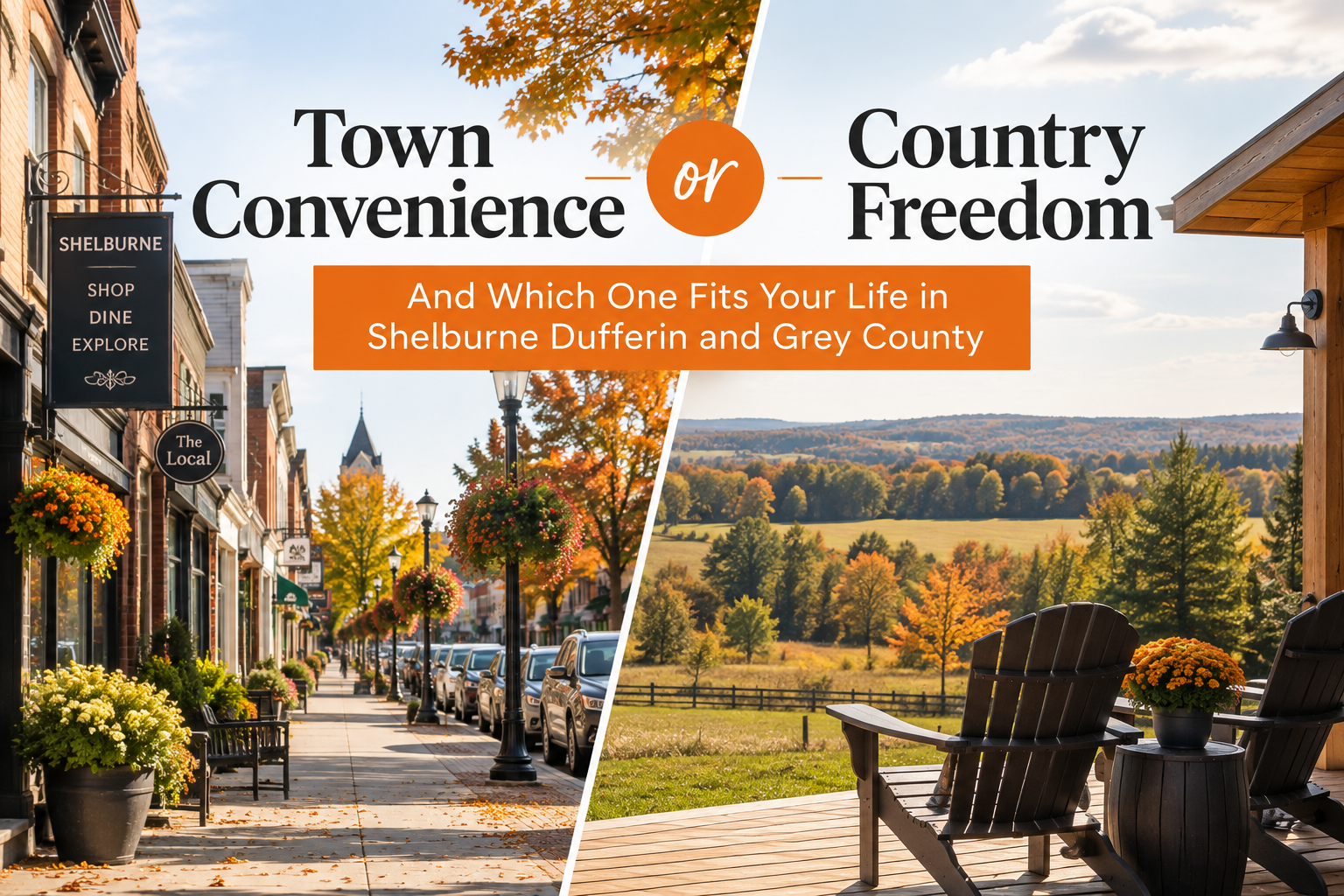
The real question behind this kind of move is not which house photographs better or which listing has the longer driveway. It is whether the life that comes with that property actually works on a regular day, not a dream day.
There is a meaningful difference between loving a showing on a sunny weekend in October and managing a regular Tuesday morning in February. The school run, the grocery trip, the after-school activity, the work call that ran late, the roads that have not been plowed yet. That is the version of your life that should be driving this decision.
Buyers in Dufferin and Grey County feel two strong pulls at once. On one side, towns like Shelburne, Orangeville, Dundalk, Markdale, Hanover, and Owen Sound offer the kind of convenience that makes a packed week easier to manage. On the other side, rural areas like Mono, Amaranth, Mulmur, Southgate, Grey Highlands, rural Meaford, and rural Chatsworth offer space, privacy, and a pace of life that genuinely cannot be replicated on a 50-foot lot.
This decision carries more weight now than it did even five years ago. Growing communities are changing what buyers can access locally, from new schools and recreation facilities to expanded healthcare services and everyday retail. That shift matters for families, upsizers, relocators, and lifestyle buyers who are all trying to figure out the same thing: which version of this region actually fits their life?
This article works through that question practically, comparing lifestyle factors that shape daily life rather than just listing features on a spec sheet.
Start With Your Hardest Weekday
The most useful filter for this decision has nothing to do with square footage or lot size. It is how your home choice affects the parts of your week that are already the most logistically demanding.
School mornings are a good place to start. If you have kids who need to be somewhere by 8:15 AM and you are also trying to get to a job, a rural property that adds 20 minutes of driving in each direction changes the math quickly. Grocery runs that take 10 minutes from a Shelburne subdivision can turn into a 45-minute round trip from a country property outside Dundalk or in the hills of Mulmur. Add an after-school activity, a pharmacy stop, or a medical appointment, and those individual trips start stacking up into something that feels less like freedom and more like a second job.
Town living tends to compress that friction. More things are closer together, which means less time in the car and more flexibility when plans change last minute. That is not a glamorous selling point, but it is one that households with busy schedules consistently underestimate until they are living it.
Country living flips the trade. The privacy is real, the space is real, and the quiet is genuinely different from anything you get inside town limits. But so is the driving, the planning ahead, and the self-management that comes with a larger property. Firewood does not stack itself. Driveways do not plow themselves. And when the internet goes out on a work-from-home Wednesday, there is no coffee shop two blocks away to bail you out.
The honest version of this decision comes down to friction tolerance. Every household has a different threshold for how much distance, unpredictability, and maintenance they are comfortable absorbing into their routine. Getting specific about that number before you start booking showings saves a lot of second-guessing later.
When Convenience Wins and When It Really Matters
Walkability rarely makes the top of a buyer's wish list until the day they realize they can walk to the pharmacy at 7 PM on a Thursday without getting in the car. That shift in thinking happens faster than most people expect.
In-town living across this region offers consistent access to the things that shape daily life most directly. Orangeville has a walkable downtown core, transit routes, an extensive trail network, and a recreation centre with programming that covers most age groups. Shelburne has a recreation complex, in-town food options, and a growing commercial strip that has expanded alongside its population. Hanover functions as a regional service hub for Bruce and Grey Counties, with healthcare, retail, and schools that serve a wide surrounding area. Owen Sound sits at the top of that list for amenity depth, with a hospital, a broader retail base, cultural venues, and services that smaller towns in the region cannot match.
These distinctions matter most for specific household types. Young families juggling school schedules, extracurriculars, and two working parents tend to feel the benefit of town living most sharply. Downsizers who have already done the rural chapter and want less maintenance without moving back to the city find that places like Shelburne and Markdale hit a useful middle ground. Households managing regular medical appointments, whether for young children, aging parents, or ongoing care needs, find that proximity to services is not a preference but a practical requirement.
Growing centres like Shelburne, Dundalk, and Markdale are also pulling in a specific type of buyer: someone who wants a smaller-community feel without giving up the basics. These towns are not trying to be Orangeville or Owen Sound, but they are adding the kinds of services that make everyday life more manageable without requiring a 40-minute drive.
The straightforward case for town living is fewer windshield hours. That might sound minor until you calculate how many hours per week you are currently spending in the car and then add the extra driving that a rural property would layer on top of that. For some households, the number is fine. For others, it becomes the detail that quietly reshapes the whole decision.
Where Country Living Pays You Back
Space is the obvious draw, but it is worth being specific about what that actually means in practice. A rural property in Mono, Mulmur, or Amaranth is not just a bigger backyard. It is a fundamentally different relationship with where you live.
Buyers drawn to areas like Grey Highlands, rural Meaford, and rural Chatsworth are often looking for something that town lots simply cannot offer. Room for a workshop or a barn. Space for a large garden or a small hobby farm. Enough land to keep animals without worrying about neighbours 20 feet away. The ability to run a small business from the property without zoning complications. These are not lifestyle luxuries for the buyers who want them. They are the whole point.
Tradespeople and hobbyists consistently rank rural properties higher for this reason. A 2-acre lot outside Southgate or in the hills above Dundalk can accommodate outbuildings, equipment storage, and working space in a way that an in-town property never will, regardless of how large the house itself is. Families who have outgrown their current home and want room for kids to actually use the land, not just look at it through a window, find that rural properties deliver that in a way that a larger subdivision lot does not.
Then there is the less tangible side of it. Dark skies. Trail access directly from the property. Views that are not interrupted by another roofline. The kind of quiet that takes a few nights to get used to if you have spent your whole life near a main road. These are real quality-of-life factors that show up in how people feel about where they live, not just what they own.
Balancing that honestly means acknowledging what comes with it. Rural properties require more from their owners. Maintenance on a larger lot and older systems takes time and money. Driving becomes a constant rather than an occasional inconvenience. Seasonal upkeep, from snow removal on a long lane to managing drainage on acreage, adds up across a year. Buyers who go in with clear eyes about those responsibilities tend to love rural life. Buyers who underestimate them tend to list again within three years.
Schools Healthcare and Errands That Shape Daily Life
Family buyers often reach a tipping point in this decision when they start working through the logistics of school, healthcare, and regular errands rather than just the property itself.
School access looks straightforward on a map until you factor in bus routes, catchment boundaries, before and after care availability, and whether the programs your kids need are actually offered at the school they would attend. Rural families frequently find that school logistics require more coordination than they expected, particularly for younger children who cannot yet manage an independent commute. Verifying specifics directly with the relevant school board before committing to a property is worth doing early, not after an offer is accepted.
Dundalk and Markdale are worth noting for younger families specifically. Both communities have seen growth that has brought infrastructure changes, including school-related investments that reflect the increasing number of families choosing those areas. That does not mean the logistics disappear, but it does mean the picture is more complete than it was even a few years ago.
Healthcare access follows a similar pattern. Proximity to Orangeville or Owen Sound carries real weight for households with young children, aging parents, or anyone managing ongoing medical needs. Not every hospital in this region offers the same level of emergency care, diagnostic services, or specialist support. Collingwood General and Marine Hospital, Headwaters Health Care Centre in Orangeville, and Grey Bruce Health Services in Owen Sound each serve different catchments and offer different service levels. Knowing which facility is closest to a property, and what it actually provides, is a detail that matters more than most buyers realize until they need it.
Errands are the quieter version of the same calculation. A rural household in Grey Highlands or rural Chatsworth may be doing a larger consolidated grocery run once a week rather than stopping in on the way home from work. That works well for some households and creates friction for others. Getting specific about your current errand patterns before choosing a location gives you a much more honest read on how well a rural address will actually fit.
The Driveway Test Commutes Winter and Weekend Reality
Rural properties have a way of looking different in March than they did in September. The lane that seemed charming at the showing becomes a 200-metre commitment to snow removal every time it storms. The gravel road that was fine in October turns into a spring mud situation that adds 15 minutes to every departure. These are not dealbreakers for buyers who know what they are getting into. They are dealbreakers for buyers who did not ask.
Commute length is the version of this that hits hybrid workers hardest. Someone driving into Brampton or Mississauga two or three times a week from a rural property outside Mulmur or in the hills above Chatsworth is looking at a meaningful daily time investment. A round trip that takes 90 minutes from a town property can easily stretch to two and a half hours from a rural address, and that gap compounds across a work week quickly.
The seasonal reality check is worth doing deliberately. Ask whether the property still fits when roads are icy, daylight ends at 4:30 PM, and the household is managing school, work, and winter obligations simultaneously. Some buyers do that calculation and decide rural life is exactly what they want year-round. Others realize that what they are actually chasing is a country weekend, not a country lifestyle seven days a week.
That distinction matters more than it might seem. A buyer who wants the trails, the fire pit, the slower pace, and the views on Friday evening through Sunday afternoon is solving a different problem than a buyer who wants those things as their permanent daily reality. Conflating the two leads to purchases that feel right at the showing and wrong by the following February.
Road maintenance responsibility is another variable that catches buyers off guard. Some rural properties sit on municipally maintained roads. Others rely on private lane agreements or shared access arrangements that put maintenance costs and coordination directly on the homeowner. Clarifying this before an offer removes a category of surprise that can get expensive fast.
Maybe You Want a Weekend Life Not a Full Time Rural Life
Some of the strongest demand in this region comes from buyers who are not actually trying to solve a housing problem. They are trying to solve a lifestyle problem, and they have decided that a property near trails, water, or open land is the answer.
Areas near Mono Cliffs Provincial Park, the Beaver Valley in Grey Highlands, the shores of Georgian Bay near Meaford, and the Niagara Escarpment corridor running through Mulmur and Nottawasaga attract buyers who want slower weekends without giving up the convenience of their primary residence. That pull is real and completely legitimate. The issue is when buyers try to solve both goals with a single purchase.
A family relocating from Vaughan or Mississauga who wants a full-time home with good school access, manageable commutes, and everyday convenience is making a different decision than a couple from Toronto looking for a recreational property they can use on long weekends and during summer. When those two goals get mixed together, the result is often a property that does neither job particularly well.
For buyers in the first group, staying closer to a town centre while building in access to recreation, whether through trail proximity, a short drive to skiing or paddling, or a property with enough land to feel like a retreat, often hits the better balance. Shelburne, for example, sits close enough to the Dufferin County trail network and the hills of Mulmur that buyers can get meaningful outdoor access without fully committing to rural infrastructure. Markdale puts buyers near the Beaver Valley Ski Club and Grey Highlands trail systems while still offering in-town services.
For buyers in the second group, the recreational property market in Grey County and southern Georgian Bay genuinely delivers. Rural Chatsworth, rural Meaford, and the Grey Highlands area offer properties with land, privacy, and access to outdoor recreation at price points that are still more accessible than Muskoka or Prince Edward County. The trade is that these properties come with well and septic systems, gravel roads, and seasonal access considerations that require due diligence before purchase rather than after.
Separating what you want on a long weekend from what you need on a regular Wednesday is the exercise that makes this decision cleaner for almost every buyer who works through it honestly.
What Smart Rural Sellers Should Answer Up Front
Rural buyers are not just buying a house. They are buying a well, a septic system, a driveway, a road, a heating system, and often a collection of outbuildings, each with its own age, condition, and maintenance history. The sellers who understand that tend to attract more serious buyers and fewer deals that fall apart mid-process.
The questions that come up most consistently in rural transactions cluster around a few key areas. Septic age and service records matter because a system that is 25 years old and has never been pumped is a liability that buyers will price into their offer or walk away from entirely. Well type and depth, along with recent water test results, give buyers confidence that the most basic system on the property is functioning properly. Internet availability is no longer a secondary concern, particularly for remote workers, and sellers who can confirm provider options and actual speeds remove a significant source of hesitation.
Beyond systems, buyers want clarity on easements and right-of-way agreements, road maintenance responsibility for private lanes, utility costs across seasons, and the condition of any outbuildings that are included in the sale. A workshop that looks usable from the outside but has a failing foundation or unpermitted electrical is not an asset. Sellers who document these details honestly, rather than leaving buyers to discover them during inspection, consistently move through transactions more smoothly.
The practical reality is that rural buyers tend to do more due diligence than town buyers, not because they are more cautious by nature, but because the systems involved require it. A seller who anticipates those questions and provides answers upfront signals that the property has been cared for and that there are no unpleasant surprises waiting after the keys change hands. That kind of transparency does not just build trust. It shortens the time between interest and a firm offer.
Choosing Based on Your Real Life Not Your Best Day
This decision is less about town versus country as an abstract preference and more about which version of daily life actually holds up under normal conditions.
Towns like Shelburne, Orangeville, Dundalk, Markdale, Hanover, and Owen Sound consistently win on time, convenience, and access to services. The trade is smaller lots, closer neighbours, and less room to do the things that require space and privacy. Rural areas like Mono, Amaranth, Mulmur, Southgate, Grey Highlands, rural Meaford, and rural Chatsworth win on land, freedom, quiet, and the kind of recreational lifestyle that cannot be manufactured on a subdivision street. The trade is more driving, more maintenance, and more self-sufficiency.
Neither is wrong. Both are real. The buyers who end up happiest with their choice are the ones who based it on their actual routines and responsibilities rather than the version of their life they are hoping to build someday.
Choosing based on your real schedule, your real tolerance for driving, and your real capacity for property maintenance gives you a much more reliable compass than choosing based on how a property felt on a warm Saturday afternoon. The best move is the one that still feels right in February, not just the one that looked beautiful at the showing.
Check out this article next