

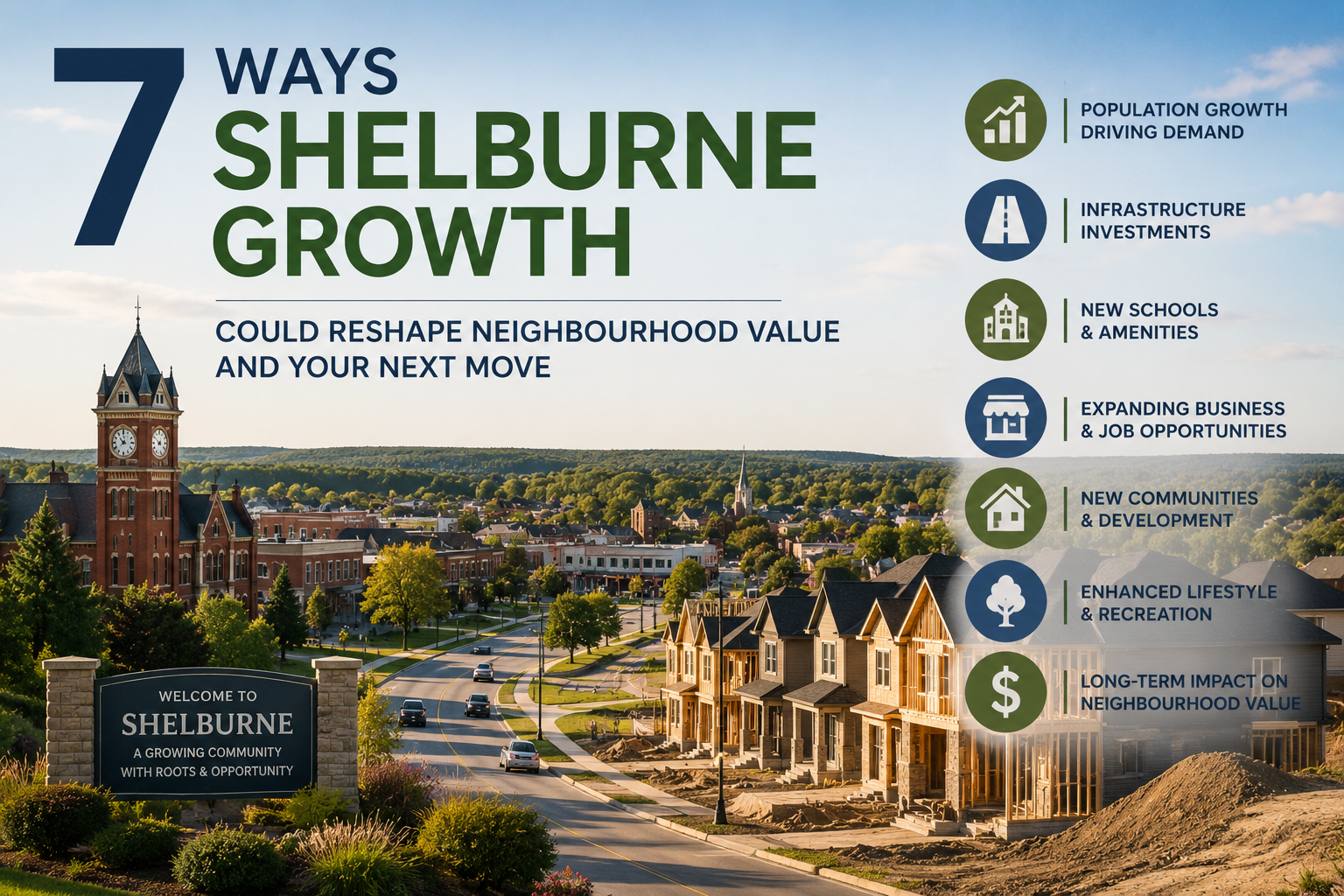
Shelburne added nearly 900 residents between 2016 and 2021, pushing its population to 8,994 — and that kind of growth doesn't just fill up new subdivisions, it quietly rewrites what different parts of town are actually worth living in. For homeowners thinking about selling in 2026, the obvious question is what your home will fetch, but that's honestly only half the conversation. The more interesting question is what Shelburne itself will look like by the time you hand over the keys — and whether the neighbourhood you move into next will actually suit the life you want. Growth changes things that don't show up on a listing sheet, things like how long it takes to get out of your street in the morning, whether the nearest school still has room for your kids, and whether the coffee shop you liked is now buried behind a construction hoarding. In a 2026 market where inventory is expected to see modest gains but buyer demand stays steady, getting the sale price right matters — but so does making a move that holds up a few years down the road. This article gets into seven specific ways Shelburne's growth could shift neighbourhood appeal, buyer priorities, and your own options, whether you're thinking about upsizing, downsizing, or just trading one part of town for another. Some of what's coming might be obvious, but a few of these shifts tend to catch even long-time residents off guard.
Way 1 Growth Is Rewriting Which Parts of Shelburne Feel Most Valuable
Not every street in Shelburne is on the same trajectory. Some pockets are quietly becoming more attractive as the town fills in around them, while others — despite being newer — are sitting further from the action in ways that buyers are starting to notice.
Where Buyer Attention Is Actually Going
When a town grows, the things that used to be nice-to-haves start feeling more like necessities. A short walk to a park, a school within a reasonable distance, a grocery run that doesn't require a full tank of gas — these details carry more weight when more families are competing for the same limited supply of well-located homes. Mature trees and larger lots also factor in here, not just for aesthetics but because they're genuinely harder to replicate in newer developments where every square metre of land has already been accounted for.
Older, more central parts of Shelburne tend to attract buyers who want character and convenience — the kind of home that already feels settled into the town rather than tacked onto the edge of it. Newer subdivisions on the outskirts appeal to a completely different buyer — someone who prioritizes fresh finishes, modern layouts, and the idea of being the first person to use the dishwasher. Neither is a wrong choice, but they're not interchangeable either, and treating them as if they compete on the same terms misses the point entirely.
What This Means for Your Specific Home
Worth sitting with for a moment is the question of what your own street actually offers right now — not compared to some abstract ideal, but relative to what buyers in 2026 are likely to prioritize. Does your home sit close to schools, shops, or green space that has become more accessible as Shelburne has grown? Does it have the kind of lot size or mature landscaping that newer builds simply can't offer? Or does it have newer finishes and a layout that appeals to buyers who want move-in ready without the renovation math? Each of these is a legitimate selling point, but only if you know which one you're actually working with.
Selling from a position of genuine demand — rather than just general market activity — tends to produce better outcomes. A home that has quietly become more central as Shelburne expands, or one that now sits closer to amenities that didn't exist five years ago, may have a stronger window in 2026 than its last assessed value would suggest. Shelburne's own strategic planning work has aimed to "identify key themes, challenges, and long-term goals" for the community, which signals that infrastructure and services are being deliberately directed — and that direction will keep reshaping which parts of town feel most worth buying into.
Way 2 Your Commute and Work Setup Now Shape Buyer Demand
Hybrid schedules have fundamentally shifted how far buyers are willing to travel for work. According to the National Association of REALTORS®, "people are willing to live farther from the office if they only need to commute a few days a week," and nearly 60% of homebuyers who work remotely say they would consider a longer commute in exchange for more space. That math changes everything about which towns end up on a buyer's shortlist — and which ones get quietly dismissed.
Shelburne fits this new calculation better than most people give it credit for. It's not just a town you drive through on the way to somewhere else — it sits close enough to Orangeville, Brampton, and the Highway 10 corridor to make a two-or-three-day-a-week commute genuinely manageable, while still offering the kind of square footage and breathing room that buyers working from home actually need. That combination — part commuter, part remote-capable — is exactly what a growing segment of buyers is hunting for right now.
When buyers are weighing a home in a town like Shelburne, a few specific features tend to move the needle on perceived value more than others —
- Proximity to main driving routes and highway access — homes that sit closer to Highway 10 or have a straightforward path to the 400-series highway network carry a practical edge for buyers who still commute part of the week. That accessibility isn't just a convenience; it directly affects how sustainable the lifestyle feels long-term, which influences how seriously a buyer considers the home at all.
- Reliable high-speed internet — "reliable broadband is now one of the top features buyers want," according to NAR research. A home without a dependable connection isn't a remote-work home; it's just a house that's far from the office. Buyers with hybrid arrangements treat internet infrastructure the same way they'd treat a functioning furnace — non-negotiable.
- A usable home office or flexible extra room — NAR economists note that "a home office is no longer just a 'nice-to-have' feature; it has become a necessity for many buyers." A dedicated room that can hold a desk, a door that closes, and enough space to take a video call without the kitchen in the background — that specific setup adds real, functional value that buyers price into their decisions.
- A layout that supports part-time work-from-home routines — open-concept designs can work against buyers who need separation between work and living space. Homes with a defined room away from the main living area, even a finished basement or a converted den, give buyers the flexibility to actually use the house the way their schedule demands.
Driving the route you're considering on a Tuesday morning at 7:45 AM will tell you more than any map app ever will. Distance in kilometres means very little when the actual experience is stop-and-go traffic through Orangeville or a slow crawl onto the highway. Testing the commute at real hours, on real days, is the only honest way to know whether the location actually works for your life. Weekly livability — how the house functions across a full Monday-to-Friday — is what buyers are weighing in 2026, not just how many kilometres separate the driveway from downtown.
No source link or source content summary was provided, so no external linking can be added.
Way 3 Schools Can Quietly Push One Neighbourhood Ahead of Another
Family buyers move fast when the school situation is sorted. A home that sits within a reasonable walk of a well-regarded elementary school often gets an offer before the one with the bigger kitchen island two streets over. Square footage matters, sure — but for parents with young kids, the daily logistics of drop-off, pickup, and not spending forty minutes in a car before 8 AM tend to win the argument pretty quickly.
That pattern of decision-making has a direct effect on which streets in Shelburne attract the most competition. When families consistently target the same catchment areas, those pockets of town start pulling ahead — not because the homes are dramatically different, but because the location solves a specific problem that buyers with children aren't willing to compromise on. Over several years, that preference compounds into real price differences between streets that look nearly identical on paper.
What Enrolment Pressure Does to Buyer Demand
Shelburne's population growth is putting real strain on local school capacity, and that pressure is already shaping how buyers think about specific neighbourhoods. When a school starts running near or at capacity, the catchment boundary becomes a hard line — and buyers who fall just outside it know their kids may not get a spot at the school they were counting on. That uncertainty alone is enough to push serious family buyers toward homes that are clearly within the boundary, even if it means stretching the budget.
A home within a comfortable walk of an elementary school carries a different kind of appeal than one that requires a drive. Beyond the obvious convenience, walkability to school signals to buyers that the neighbourhood was designed with families in mind — and that tends to attract more of them over time. If the Upper Grand District School Board or the Dufferin-Peel Catholic District School Board moves forward with any school expansions or new builds in response to growth, the areas surrounding those sites will likely see a bump in buyer interest well before the construction is finished.
What to Check Before You Commit to a Neighbourhood
Before settling on where to buy next, it's worth pulling up the school board's current catchment maps and looking at any publicly available capacity data for the schools in that area. Both the Upper Grand District School Board and the Dufferin-Peel Catholic District School Board publish information about enrolment and school boundaries, and cross-referencing those details against a neighbourhood you're considering can save a significant amount of frustration later — especially if school access is a factor in your household.
For sellers, this is also a positioning conversation. A family home that sits within walking distance of an elementary school should have that detail front and centre in the listing — not buried at the bottom of the feature sheet. Buyers with children are often filtering by school zone before they even look at photos, so making the catchment information easy to find in the marketing can determine whether the right buyers ever see the home at all.
School access shapes where families compete hardest for homes and where sellers hold the most leverage — and in a 2026 Shelburne market with steady family-driven demand, that distinction is worth taking seriously.
Way 4 Daily Convenience Is Becoming a Bigger Part of Home Value
School proximity gets a lot of attention from buyers, but it's really just one piece of a much larger calculation. Once families start tallying up the weekly driving — groceries on Wednesday, a doctor's appointment Thursday, soccer practice Friday, and a café run somewhere in between — the total time spent behind the wheel starts to feel less like a minor inconvenience and more like a part-time job. Buyers are increasingly factoring that reality into which neighbourhoods they'll seriously consider, and which ones they'll quietly pass on.
This shift has made certain pockets of Shelburne more appealing than their listing photos alone would suggest. Areas where a resident can handle most of their weekly routine without leaving a tight radius — a grocery store, a park, a clinic, a café, and a recreation facility all within reasonable reach — are starting to attract a different kind of attention. According to the National Association of REALTORS®, "convenient access to shopping, schools, and public transportation are among the top neighborhood features homebuyers desire," and notably, "homebuyers are willing to trade off square footage for a more walkable neighborhood." That's a meaningful shift in priorities, and it has real implications for which Shelburne streets hold their value as the town continues to grow.
A straightforward way to test how your current neighbourhood — or a potential next one — actually performs is to map out your own weekly routine on paper. Work through it sequentially —
- Groceries — note where you shop most often and how long it takes door to door on a typical weekday
- Parks and green space — identify the closest usable park or trail and whether you'd walk or drive to get there
- Healthcare — mark your family doctor, dentist, and pharmacy, then check how far each sits from the homes you're weighing
- Recreation — add your gym, sports facility, or community centre to the map
- Cafés and casual dining — these matter more than they sound, since they're often the spots that signal whether a neighbourhood has genuine daily life or just houses
- School or childcare — if relevant to your household, add the specific location rather than just the catchment boundary
- Social visits — note where your closest family members or regular social connections live, since this one tends to get overlooked until someone moves too far away
For busy families, this kind of mapping often reveals just how much of their week is spent in transit between obligations. Shaving even twenty minutes off the daily routine adds up to hours across a month, and that time has real value. For downsizers, the calculation shifts slightly — they're often less concerned with school logistics and more focused on whether they can handle daily errands independently without relying on a car for every single trip. "Sixty percent of younger buyers said that they wanted to be able to walk to stores, restaurants, and parks," but the appeal of walkability isn't limited to younger demographics. Downsizers and empty nesters consistently rank low-maintenance, accessible neighbourhoods as a top priority when choosing where to land next.
Running this exercise honestly tends to produce a clear answer about what kind of move actually makes sense — staying put if the current location already covers most of the map well, shifting closer to Shelburne's town centre if the gaps are significant, or accepting the trade-off of a quieter edge-area home where the driving is real but the space and price make it worth it.
Way 5 Older Streets and New Subdivisions Will Not Win the Same Buyers
Shelburne's expansion isn't creating one unified housing market — it's creating two separate ones that happen to share a postal code. The buyers drawn to a well-established street near the town centre are not the same people scrolling through listings in a freshly paved subdivision on the edge of town, and the more Shelburne grows, the more those two groups pull in opposite directions. Growth doesn't homogenize buyer preferences; it tends to crystallize them.
That divide matters for anyone selling in 2026, because positioning a home correctly means understanding which pool of buyers you're actually speaking to. A home marketed to the wrong audience — one that leads with lot size to buyers who want low maintenance, or emphasizes new finishes to buyers who specifically want character — is a home that sits longer than it needs to.
Why Older Neighbourhoods May Gain Momentum
Established streets in Shelburne carry something that no new subdivision can manufacture on a timeline — a sense that the neighbourhood has already figured itself out. The trees are tall enough to provide actual shade, the lots are wide enough that neighbours aren't staring into each other's kitchens, and the distance to the town centre is measured in minutes on foot rather than minutes in a car. Real estate agent Cara Ameer has noted that buyers choose older homes because they don't want "a cookie-cutter neighborhood" with "no trees or mature landscaping." That preference is showing up in Shelburne's established pockets, where the streetscape alone does the selling for a certain type of buyer.
What growth adds to this equation is renovation activity. As more people move into Shelburne and the town's core becomes more valuable, homeowners on older streets tend to invest more heavily in updates — new kitchens, finished basements, refreshed exteriors — which gradually raises the standard of the whole area without erasing its character. "Lot sizes tend to be larger with older homes," and builders in newer areas "squeeze everything on 40- to 60-foot-wide lots," which means the spatial generosity of an older Shelburne street becomes a harder-to-replicate selling point over time.
Why Newer Subdivisions Appeal to a Different Buyer
The buyers heading toward Shelburne's newer subdivisions aren't settling — they're optimizing for a completely different set of priorities. An attached garage, an open-concept main floor, triple-pane windows, and a high-efficiency HVAC system aren't just features; they're a specific kind of promise that the home will cost less to run and require less immediate attention. For buyers who've already spent years managing an older property, that promise carries real weight.
Move-in-ready appeal is the other side of this. Agent Libby McKinney-Tristchler has observed that many buyers are "not interested in spending weekends maintaining big houses or oversized properties" — and newer subdivisions on the outskirts of Shelburne deliver exactly that kind of predictability. Smaller lots, newer mechanicals, and builder warranties reduce the mental overhead of homeownership in a way that genuinely appeals to buyers who want their weekends back.
Thinking like a buyer means asking what your specific home offers that the alternatives nearby simply don't — whether that's a mature lot and a walkable location, or a modern layout and a garage that fits two cars without a shoehorn. That answer shapes not just how you sell, but where you go next.
Way 6 Town Plans and Infrastructure Can Create Tomorrow's Strongest Pockets
Current buyers are focused on what a neighbourhood offers right now — the nearest grocery store, how long the school pickup line runs, whether the street feels finished. But the homes that hold their value best over the next decade tend to sit in areas where the town's own plans are quietly working in their favour, often years before the improvements are visible from the curb.
Shelburne's Planning and Development Department is responsible for "long range planning, development review, zoning, heritage, and business licensing" — and the documents that come out of that department are essentially a roadmap for where convenience is headed next. "Planning documents provide the framework for how land is used and how the Town will grow over time," which means a homeowner willing to read those documents has access to the same information developers use when deciding where to build. Most buyers never bother, which is exactly why the ones who do tend to make better decisions.
The specific signals worth tracking in Shelburne's planning materials are —
- Road upgrades — when a road gets widened, resurfaced, or extended to connect previously isolated streets to main corridors, travel times drop and the surrounding area becomes more accessible. That accessibility tends to attract retail and services, which then attract more buyers. A street that currently feels disconnected can shift meaningfully once a road project is completed.
- School additions or expansions — new school capacity in a specific area signals that the town expects sustained family growth there. Families follow schools, and when a new or expanded school gets approved for a particular part of Shelburne, the homes within walking distance of that site typically see increased buyer interest before the building is even finished.
- Trail and park development — green space that gets formally connected into a trail network becomes a daily-use amenity rather than an occasional destination. Buyers who want outdoor access without driving to it pay attention to which neighbourhoods sit closest to those connections.
- Future retail and commercial growth — a planned commercial node nearby means that residents will eventually be able to handle more of their errands locally. That shift reduces driving time and adds the kind of walkable convenience that buyers increasingly factor into their decisions.
- Community centres and service expansion — a new recreation facility or expanded municipal service hub changes the daily rhythm of a neighbourhood. These projects also signal long-term municipal investment in an area, which tends to stabilize and improve surrounding property values over time.
- Land-use and zoning changes — when the town adjusts zoning to allow mixed-use development or higher-density residential, it often signals that an area is being positioned for growth. Those changes typically precede the amenity improvements that make a neighbourhood genuinely more livable.
Buying a new build in an area that currently lacks services is a reasonable bet — but only if the planning documents suggest those services are actually coming. Sellers in parts of Shelburne that are currently undergoing this kind of infrastructure attention may be sitting on more value than their last assessment captured, and listing before the improvements are complete often means leaving money on the table.
Way 7 The Best Next Move Starts With Lifestyle Fit, Not Perfect Market Timing
All six of the shifts covered in this article — schools, commute patterns, infrastructure plans, walkability, neighbourhood character, and buyer priorities — ultimately feed into one personal question: does your next move actually suit the life you're living? The town-level picture matters, but it only tells you where demand is heading, not whether a specific home in a specific part of Shelburne will work for your household three years from now. That gap between market data and personal fit is where most moving decisions go sideways.
The 2026 Shelburne market is expected to bring modest price movement and a slight improvement in available inventory — which means buyers will have a bit more to choose from and a bit less pressure to decide in forty-eight hours. That measured pace is actually good news for sellers who want to move thoughtfully rather than reactively. Hitting the absolute peak of a price cycle is less important than landing in a home that genuinely supports how you spend your time, because a poorly chosen next home costs you in ways that don't show up on a closing statement.
When the Right Home Matters More Than the Right Month
HUD frames homebuying as a decision rooted in personal needs rather than market timing, noting that buyers should "think about your lifestyle, your future needs, and how long you expect to stay in the home." That framing holds for sellers too. A move that improves your daily quality of life — shorter commute, less maintenance, closer to family, better suited to how your household actually functions — delivers returns that compound over years, regardless of whether you sold at the precise top of the market.
Waiting for a perfect pricing window while living in a home that no longer fits is its own kind of cost. The 2026 market won't punish sellers who move with clear purpose — it will reward homes that are well-positioned and priced honestly, which means the preparation matters far more than the calendar date.
Whether Your Current Neighbourhood Still Fits
HUD's guidance asks buyers to consider "how will your job, family, or other needs affect your housing needs now and in the future" — and that question applies just as directly to the home you're leaving as the one you're moving into. If your commute has gotten longer since you moved in, your family's space needs have shifted, your maintenance load has grown past what you want to manage, or the amenities you actually use are now a twenty-minute drive away, those aren't minor inconveniences — they're signals that the neighbourhood has stopped working for your current life.
What This Looks Like in Practice
Upsizers are often weighing whether a larger home in a newer subdivision justifies the distance from the town centre. The honest answer usually depends on whether the extra space solves a real daily problem — a growing family, a need for a proper home office, or a yard that gets used — rather than just looking better on paper.
Downsizers tend to benefit most from moves that reduce the maintenance burden and bring daily errands within closer reach. A smaller home in a more central part of Shelburne often delivers more usable daily convenience than a larger one on the outskirts, even if the square footage trade-off feels uncomfortable at first.
Remote workers have the most flexibility in where they land, but that flexibility can work against them if they don't anchor the decision to something concrete. Reliable internet, a room that functions as a proper workspace, and a neighbourhood with enough daily life to prevent cabin fever are the three things that actually determine whether a remote-work home holds up over time.
People relocating within Shelburne are often underestimating how much the town's growth has already differentiated one pocket from another. A move across town isn't just a change of address — it can mean a completely different school catchment, a different commute experience, and a different level of access to the amenities that are still being built out.
Shelburne's growth is actively redistributing value across different parts of town, and that redistribution will keep moving for years. The homes that hold up best — for sellers and buyers alike — are the ones chosen because they fit a real life, not because the timing looked good on a chart.
Final Thoughts
Shelburne's growth isn't just pushing prices around — it's quietly redrawing the map of which neighbourhoods people actually want to live in. The seven forces covered in this article — shifting micro-markets, commute patterns, schools, amenities, housing type, infrastructure, and lifestyle priorities — each pull in their own direction, and together they're changing what buyers are willing to pay for and why.
That matters a lot if you're thinking about selling in 2026. A well-timed sale is great, but walking away from a sale without a clear sense of where you're going next is the kind of thing that leads to rushed decisions and buyer's remorse from the seller's side of the table. The financial piece and the lifestyle piece need to work together, not take turns.
What this article hopefully made clear is that your next move doesn't have to be a guess. Shelburne is growing in specific, trackable ways — new roads, new schools, new retail, new subdivisions — and that growth creates real patterns you can use to your advantage. Whether you're upsizing, downsizing, or just relocating to a part of town that fits your life better, the version of Shelburne taking shape right now is worth paying attention to.
So before you list, take stock of not just what your home is worth today, but what the neighbourhood around it is becoming. Then figure out where you actually want to land. That combination — financial timing plus a clear next step — is what makes a move genuinely work.
Check out this article next