

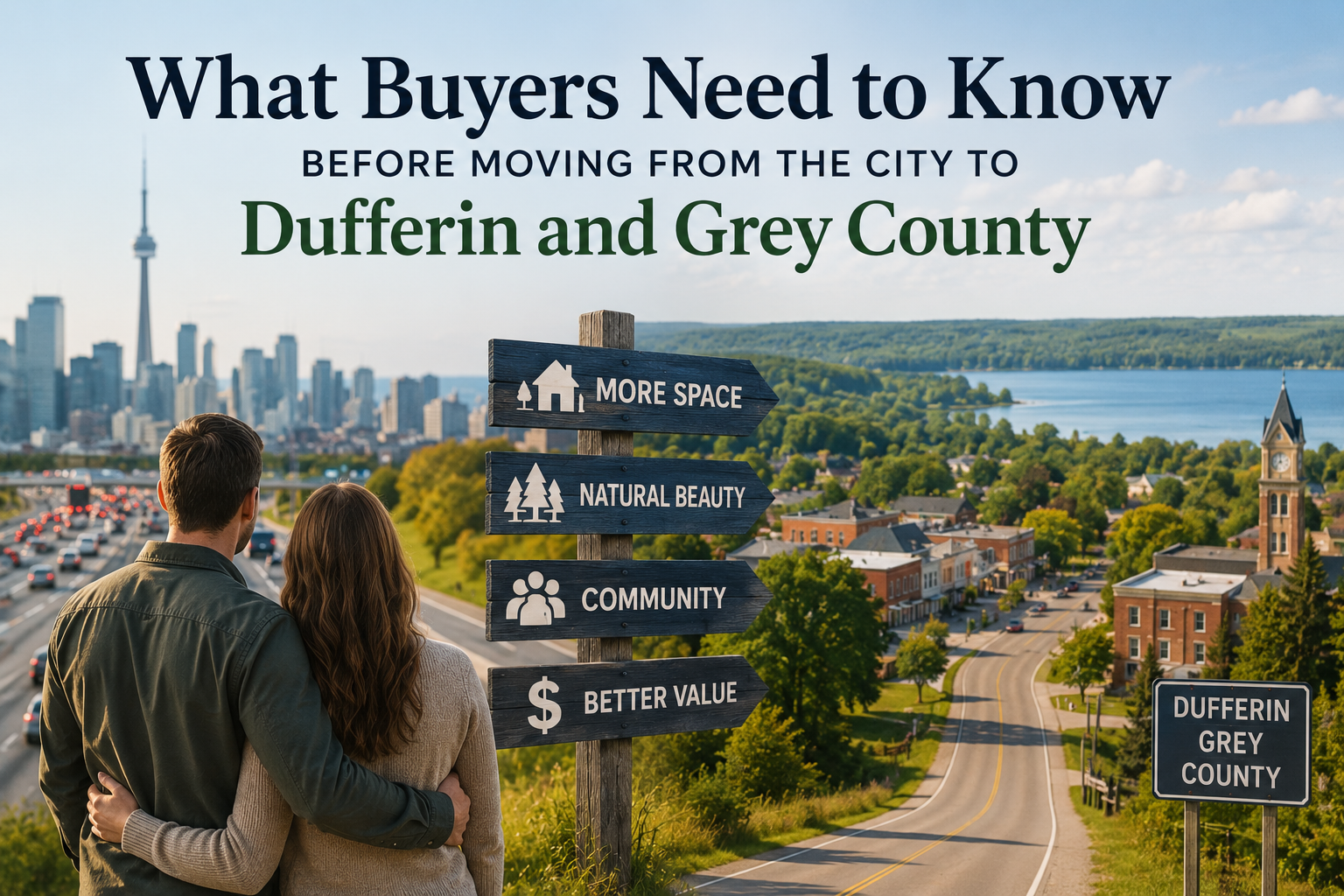
More space, better value, and a chance for your kids to grow up with actual backyards sounds appealing, but will moving from the city to Dufferin and Grey County actually make your family's daily life better or just different? Many families find themselves caught between the dream of small-town living and the reality of longer commutes, fewer amenities, and unexpected property challenges. This guide cuts through the marketing brochures and social media posts to give you the real story about what life looks like when you trade your downtown condo for a house in Shelburne or the surrounding rural areas. We'll walk through the practical stuff that matters most - how long that commute to Toronto actually takes on a Tuesday morning, what school options your kids will have, where you'll shop for groceries, and why that beautiful two-acre lot might come with a septic system that needs more attention than you expected. You'll learn about the motivations driving other families to make this move, from affordability pressures to wanting more room for kids to play, plus access to hiking trails and a pace of life that doesn't revolve around rush hour traffic. We'll also cover the surprises that catch many buyers off guard, including lot sizes that require more maintenance than anticipated, well water systems, and the reality that your nearest Tim Hortons might be a 15-minute drive away. Ready to find out if Shelburne and the surrounding communities match what your family actually needs?
I notice that no source link or source content summary has been provided in the placeholders. Without this information, I cannot determine what text should be hyperlinked or where the link should point to.
Please provide:
Once you provide this information, I'll be able to add the appropriate external link to the relevant text in the section.
I notice that no source link or source content summary was provided in your request. The and sections are empty. Without knowing what the source contains, I cannot identify relevant text to hyperlink that matches the source content.
Please provide the source link and source content summary, and I'll be happy to add the appropriate external linking to the section.
I notice that no source link or source content summary was provided in your request. The and sections are empty.
Since I cannot determine what content should be linked or where the link should point to, I'll return the original section unchanged:
Town Living and Rural Living Are Two Very Different Moves
Choosing between a house in Shelburne versus a farmhouse on five acres outside Orangeville isn't just about square footage or mortgage payments - you're selecting how your family will spend every single day for years to come.
Town living in places like Shelburne
Families who settle in Shelburne discover that municipal water, sidewalks, and having the grocery store three blocks away creates a rhythm that feels familiar yet refreshed. Your kids can bike to friends' houses without crossing busy highways, and when the washing machine breaks down on a Saturday, you won't wait until Monday for a service call because repair companies actually serve the area regularly. The lots might measure 50 by 120 feet instead of sprawling acres, but this means weekend yard work takes two hours instead of consuming entire days. Walking to the library, pharmacy, or coffee shop becomes part of your routine again, and when winter storms hit, municipal snow plows clear your street within hours rather than leaving you to handle a quarter-mile driveway yourself.
Rural living across Dufferin and Grey
Properties scattered across the countryside between Shelburne and Collingwood offer something entirely different - space that stretches beyond what city families thought possible, where your nearest neighbor might be a quarter-mile away and deer wander through your backyard regularly. These homes often sit on two to ten acres or more, giving kids room to build forts, raise chickens, or simply run without boundaries. The trade-off comes in the form of 20-minute drives to reach basic services, septic systems that need pumping every few years, and well water that requires testing and occasional treatment. When power lines go down during ice storms, rural properties often wait longer for repairs, and that beautiful long driveway becomes your responsibility to plow, salt, and maintain year-round.
Which option fits family life better
The daily realities that actually matter to families break down along these practical lines:
Assuming that more land automatically means better family living ignores how your household actually functions day-to-day. A family that values convenience, walkable errands, and minimal property maintenance might find rural acreage overwhelming rather than liberating, while families seeking space, privacy, and self-sufficiency could feel cramped in town settings regardless of the home's interior size.
The Costs and Property Details City Buyers Often Miss
Properties outside municipal boundaries operate under completely different infrastructure systems that can catch urban families off guard with unexpected annual expenses and ongoing responsibilities they never had to consider before.
Private wells and septic systems replace the municipal water and sewer connections that city dwellers take for granted, creating new budget lines that many buyers don't anticipate during their initial calculations. Rural homeowners are responsible for maintenance and repair of their septic systems, which typically need professional pumping every three to five years at costs ranging from $300 to $500 per visit. Well water systems require periodic testing, filter replacements, and occasional pump repairs that can add another $500 to $800 annually. When you factor in both systems plus emergency repairs, these private utilities often cost families between $1,000 to $2,000 per year - expenses that run 20 to 30 percent higher than the predictable monthly municipal bills most buyers budget for initially.
Heating systems present another layer of operating expenses that differ significantly from city apartments or townhomes connected to natural gas lines. Many rural properties rely on propane delivery trucks that fill outdoor tanks several times per year, with heating costs that fluctuate based on market prices and winter severity. Oil heating systems require similar delivery schedules plus annual maintenance contracts for furnace cleaning and repairs. Private road maintenance becomes the responsibility of property owners rather than municipal crews, meaning you'll contribute to grading, gravel replacement, and snow removal through road associations or handle these tasks independently. Water testing requirements mandate annual laboratory analysis to ensure well water remains safe for drinking, while internet availability often means choosing between expensive satellite connections or limited rural broadband options that cost more than urban high-speed services.
Expansive lot sizes create wonderful opportunities for gardens, play areas, and outdoor activities, but they also generate substantial maintenance obligations that consume both time and money throughout the year. Mowing two to five acres requires commercial-grade equipment or hiring landscape crews, with fuel and maintenance costs that easily exceed $1,000 annually for larger properties. Winter snow removal becomes a major consideration when your driveway stretches several hundred feet from the road to your house, necessitating either a plow truck contract or investing in your own snow blower and tractor. Proper drainage management prevents water from pooling around foundations and septic systems, sometimes requiring French drains or grading work that costs thousands of dollars. Fencing installation and repairs protect gardens and define property boundaries, while outbuildings like sheds, barns, or workshops need regular roof maintenance, paint touch-ups, and structural repairs.
Asking specific questions during property viewings helps buyers understand the true cost of ownership before signing purchase agreements. Septic systems require regular maintenance to function properly, so request records showing pumping dates, inspection reports, and any recent repairs or upgrades to gauge upcoming expenses. Well flow rates and water quality test results reveal whether the system can handle your family's daily usage and if treatment equipment might be necessary. Utility expense records from previous owners provide realistic estimates for propane, oil, or electricity costs rather than relying on general estimates. Road access agreements clarify your responsibilities for private road maintenance and snow removal, while school bus pickup locations determine whether your children can catch rides at your driveway or need transportation to designated stops along main roads.
Why Shelburne Works for So Many Young Families
Families seeking the sweet spot between urban amenities and rural breathing room discover that Shelburne delivers both without forcing them to choose one over the other. This community offers the infrastructure and services that make daily life manageable while providing the space and affordability that drew families away from expensive city markets in the first place.
Family-friendly everyday life in Shelburne
Centre Dufferin District High School and Hyland Heights Elementary School serve local families with established programs and transportation routes that eliminate the uncertainty many parents face when researching education options in smaller communities. Fiddle Park and Memorial Park provide playground equipment, sports fields, and open areas where children can safely ride bikes and play organized games within walking distance of most residential neighborhoods. The Shelburne Community Centre hosts hockey leagues, swimming lessons, and after-school programs that create natural opportunities for families to connect with neighbors and build the social networks that make small-town living rewarding rather than isolating.
Convenience without full city density
Highway 10 runs directly through Shelburne, connecting families to Brampton and the Greater Toronto Area within 90 minutes, while Highway 89 provides east-west access to other Dufferin communities and recreational areas around Georgian Bay. No Frills, Foodland, and Canadian Tire anchor the local shopping district, meaning weekly errands stay within a five-minute radius rather than requiring 30-minute drives to reach basic services. Former city residents appreciate that they can still walk to the post office, bank, and pharmacy while enjoying larger lots and lower housing costs than comparable suburban communities closer to Toronto. The transition feels less dramatic because municipal water and sewer systems eliminate the learning curve associated with wells and septic maintenance that characterizes more remote properties.
Why it stands out from more remote rural options
Shelburne maintains the community connections and municipal services that isolated farmhouses cannot provide, while still offering detached homes with yards large enough for gardens, swing sets, and outdoor activities that city condos never allowed. Families avoid the isolation that comes with properties where the nearest neighbor sits a quarter-mile away, yet they gain the space and quiet that motivated their move from urban apartments and townhomes. Emergency services, reliable internet access, and regular garbage collection continue without interruption, while the pace of life slows down enough that children can walk to school and parents can chat with neighbors during evening strolls around the block.
Projecting growth from "12,500 to 17,000" residents by 2050 demonstrates that Dufferin County recognizes Shelburne as a community positioned for sustainable expansion rather than a rural outpost struggling to maintain basic services. Municipal planners work with development consultants to ensure that new housing construction includes the parks, schools, and infrastructure that support family life rather than simply adding subdivisions without considering long-term community needs.
I notice that no source link or source content summary has been provided in your request. The and sections are empty.
Without a source to reference, I cannot determine which text in the section would be relevant for linking. Please provide the source link and content summary, and I'll be happy to add appropriate external linking to the section.
For now, here is the original section without any modifications:
Which Type of Community May Suit You Best
Each corner of this region serves different household needs, and treating every community from Shelburne to rural Grey County as identical options will lead to buyer's remorse when your daily reality doesn't match your expectations.
- Shelburne delivers structured family living with municipal reliability. Parents with elementary and high school aged children find that established school boundaries, organized sports leagues, and walkable access to medical clinics create the predictable framework that busy families need. Soccer practices happen at fields five minutes from home, piano lessons take place at the community center down the street, and when your child forgets their lunch money, dropping it off doesn't require a 20-minute round trip. Municipal garbage pickup, snow plowing, and water billing arrive on schedule without homeowner intervention, while grocery stores, pharmacies, and banking services cluster within a compact downtown core that supports quick errands between work calls. The trade-off comes in smaller lot sizes and closer neighbors, but families who prioritize convenience over acreage discover that 0.25-acre lots still provide enough space for trampolines, gardens, and backyard barbecues without overwhelming weekend maintenance schedules.
- Rural properties across Dufferin and Grey County reward families seeking self-sufficiency and outdoor exploration. Buyers who choose farmhouses on multi-acre lots gain the freedom to raise chickens, plant extensive vegetable gardens, and let children build tree houses without worrying about property line disputes or noise complaints. These locations suit families comfortable with 25-minute drives to reach grocery stores, medical appointments, and organized activities, plus the ongoing responsibility of maintaining septic systems, monitoring well water quality, and managing long driveways through winter storms. The isolation appeals to households that value privacy over proximity, but requires advance planning for everything from internet installation to emergency service response times that stretch longer than municipal areas.
- Grey County communities near Collingwood and Blue Mountain attract recreation-focused buyers. Families drawn to year-round outdoor activities find that proximity to ski hills, hiking trails, and Georgian Bay beaches creates weekend opportunities that justify higher property costs and seasonal traffic congestion. These areas work well for buyers who can afford premium pricing for location benefits, or families where one parent works remotely while the other commutes to Toronto less frequently. The lifestyle appeal comes with tourist-season crowds, limited year-round employment options, and housing markets influenced by cottage country pricing rather than permanent resident affordability.
- Matching your actual weekly schedule to community resources reveals the best fit. Count how many times per week your family needs quick access to medical care, after-school programs, grocery shopping, and social activities, then map those requirements against each area's service availability. Factor in commute tolerance levels, property maintenance capacity, and budget flexibility for higher utility costs or premium location pricing. Consider whether your household functions better with walking access to amenities or prefers larger lots that require driving to reach services.
Testing potential communities through weekday visits provides realistic insights that weekend house hunting cannot deliver. Drive the commute during Tuesday morning rush hour, run errands at local stores during regular business hours, and explore how children would actually get to school and activities. Renting short-term accommodations for a week or month before purchasing eliminates costly mistakes and confirms whether your family's daily rhythm matches the community's infrastructure and pace.
Why More City Buyers Are Making This Move Now
Demographic shifts accelerating across Ontario reveal families abandoning expensive urban centers for regions that promise both financial relief and lifestyle improvements. This migration pattern extends far beyond traditional suburban expansion, reaching communities that were once considered too remote for regular commuting but now attract buyers willing to trade proximity for purchasing power and quality of life.
Growth is shifting into Outer Ring communities
Regional population forecasts demonstrate substantial expansion heading toward areas previously overlooked by mainstream homebuyers. "Population projections indicate that Grey County's population will increase from 99,560 residents in 2021 to 149,100 residents by 2051" according to official municipal planning documents. This expansion represents a "growth rate of 50% over 30 years" that positions these communities as legitimate alternatives to overcrowded metropolitan areas. Central Ontario development patterns show sustained momentum through mid-century, with infrastructure investments following population increases rather than preceding them. Municipal planners recognize this demographic wave and adjust service delivery, school capacity, and transportation networks to accommodate families relocating from urban centers where housing costs consume disproportionate household income.
Why Dufferin and Grey County are attracting attention
Remote work arrangements fundamentally altered location decisions for thousands of professionals who previously required daily office attendance in downtown Toronto or surrounding business districts. Families discover they can maintain career trajectories while accessing housing markets where $600,000 purchases detached homes with yards instead of cramped condominiums. School districts throughout these regions offer smaller class sizes, outdoor education programs, and community involvement opportunities that urban schools struggle to provide amid budget constraints and enrollment pressures. Recreation access expands dramatically when families move within driving distance of hiking trails, ski hills, lakes, and conservation areas that provide year-round activities without expensive membership fees or crowded facilities. The pace of daily life slows enough that parents can participate in school events, children can walk safely through neighborhoods, and weekend activities don't require advance booking or lengthy travel times.
What this growth means for buyers right now
Population increases bring positive infrastructure improvements including expanded healthcare services, additional retail options, enhanced internet connectivity, and improved public transportation links to major employment centers. Municipal tax bases strengthen as more families contribute to local revenue streams, supporting better road maintenance, library services, and recreational programming that benefits all residents. However, housing inventory tightens as demand outpaces construction schedules, creating competitive bidding situations that mirror urban market pressures buyers hoped to escape. Properties that remained available for weeks now receive multiple offers within days, while rental accommodations become scarce for families wanting to test communities before purchasing. Early buyers benefit from appreciation potential as infrastructure catches up with population growth, but delayed decisions risk facing higher prices and fewer choices.
Timing becomes crucial when demographic trends accelerate faster than housing supply can respond. Buyers who research communities thoroughly, secure financing pre-approval, and maintain flexible viewing schedules position themselves advantageously in markets where desirable properties move quickly between listing and sale completion.
Final Thoughts
Moving from the city to Dufferin and Grey County represents a genuine lifestyle upgrade when the move aligns with your family's actual needs. We've covered the essential realities that matter most - daily driving becomes part of your routine, town living offers more convenience than rural properties, and hidden costs like septic systems and well maintenance add to your budget. The choice between communities depends on weighing space against accessibility.
Shelburne emerges as the practical choice for families seeking that sweet spot between room to grow and everyday convenience. The schools serve families well, amenities stay within reach, and the commute to major centers remains manageable. Rural properties offer more land but require accepting longer drives and fewer services nearby.
This information helps you avoid the common surprises that catch city buyers off guard. Understanding lot sizes, servicing differences, and travel distances before you buy prevents disappointment later. You'll ask better questions about snow removal, internet speeds, and school bus routes. These details matter more than square footage when your family settles into daily life.
The smartest move isn't necessarily the one with the biggest lot or the lowest price. It's the move that supports how your family actually wants to live. Consider your work schedule, your kids' activities, and your tolerance for driving. Match these priorities with what each community offers. Take time to visit during different seasons and talk to current residents. Your perfect fit exists when you know what questions to ask and what trade-offs you're willing to make.
Check out this article next